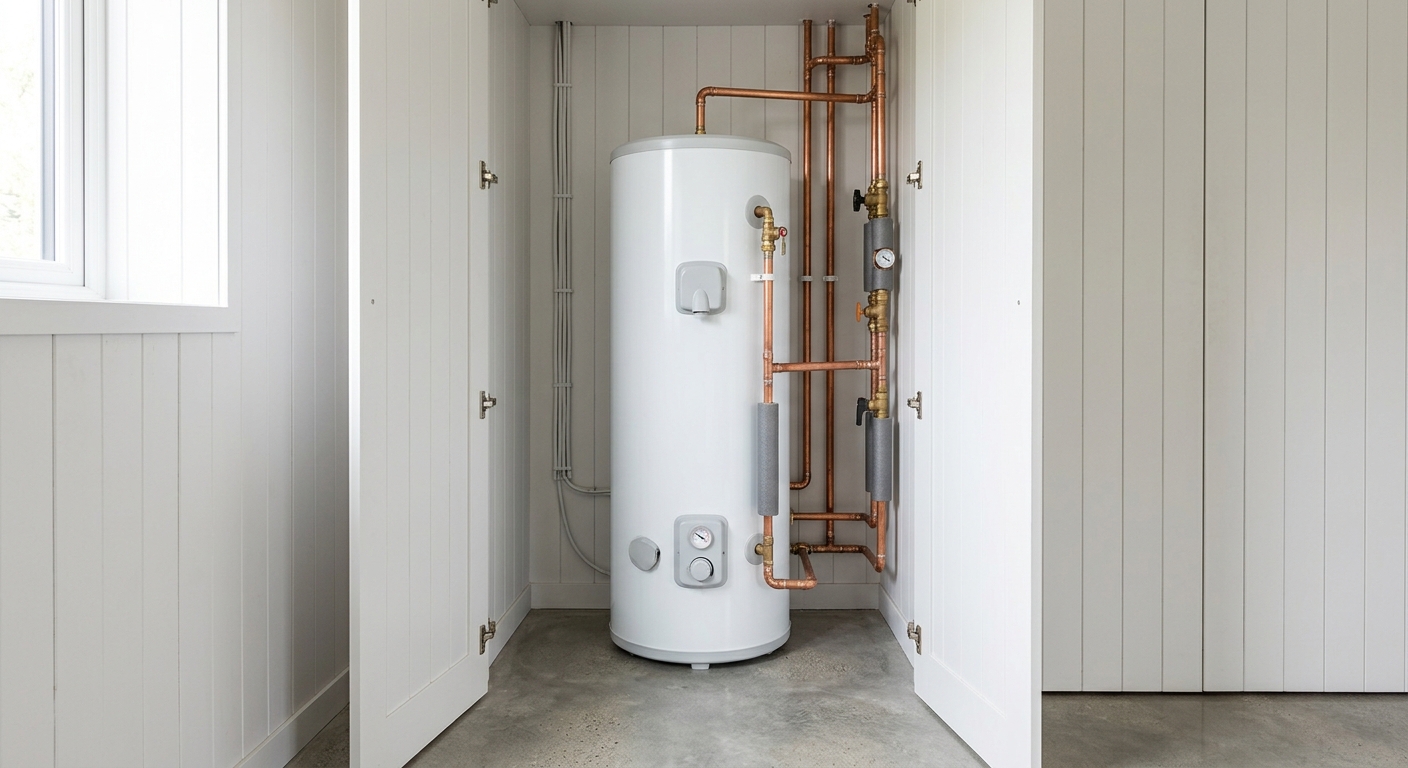
Hot showers shouldn't be a Sunday-morning lottery.
Cylinder replacements, repairs, pressure issues, slow recovery — and the calm conversation about whether a 25-year-old tank really wants to be repaired one more time. Mains-pressure and low-pressure systems, electric and gas-boosted, in single dwellings and minor dwellings.
The same six things go wrong.
Hot water systems fail in fairly predictable ways. The trick is figuring out whether the failure is a $200 fix or a $3,000 conversation.
- No hot water at all. Element, thermostat, gas valve, or — most often on older units — the cylinder itself has finally given up.
- Hot water that runs out fast. Almost always one of two things: a broken element pair, or a thermostat that's settled to a lower temperature than it claims.
- Pressure that won't push the shower. Pressure-reducing valves seize, mains pressure cylinders age out, restrictors install themselves invisibly somewhere in the chain.
- Slow recovery between showers. A fixable problem on a healthy cylinder. A “sign on the wall” on an old one.
- Discoloured or smelly water. Anode rod chewed through. Easy job if the cylinder has years left in it; not worth the investment if it doesn't.
- Weeping pressure-relief valves. Almost always a mains pressure problem, not the valve. I'll check the upstream side first.
The honest version of this conversation.
A new cylinder is a real expense. So is a series of $400 callouts on a tank that's not going to make it through winter.
When repair makes sense
If the cylinder is under 10 years old, well-installed, and the failed part is a known consumable (element, thermostat, anode, valve), repair is almost always the right call. You'll get many more years of service for a fraction of replacement cost.
If you've had hot water continuously and just had one component fail, that's not a tank problem — that's normal wear. Fix the component.
When replacement makes sense
If the cylinder is older than 15 years and you're calling about hot water for the second time this year, it's worth doing the whole-of-life maths. Cylinders fail catastrophically when they fail — through the bottom, into the ceiling cavity, often on a Sunday — and that flood costs more than the cylinder ever did.
I won't pressure you into a swap. But I will tell you honestly when I think the next call is a question of when, not if.
From phone call to first hot shower — usually one working day.
Most domestic cylinder swaps are start-and-finish-in-a-day jobs. I'll quote up front, get the unit sourced, and book the install when it suits you. If we're switching pressure type or moving location, we'll spend a bit more time on the planning side.
Brands I use most often are local — Rinnai, Rheem, Mercury, Edwards. I'll match the right cylinder to your house, your hot-water draw, and your hot-water habits. Bigger isn't always better — a properly sized 180L on mains pressure outperforms an oversized 250L every time.
Council compliance, building consent (where applicable for system changes), and certificate sign-off — all handled. You get the paperwork; I keep a copy for my records.
Other things I'm probably the right person for.
-
01
Same-day callouts for burst pipes, blocked drains, hot water failures.
-
03
Renovation rough-ins, fit-offs, single-fixture swaps.
-
04
Blocked drains, slow gully traps, downpipe and stormwater work.